How to Choose the Best Chicken Injector for Global Sourcing?
Selecting a Chicken Injector requires more than comparing prices and product photos. In practical kitchen testing, needle blockage, uneven pressure, and leaking seals quickly reveal weak designs. A reliable model should deliver marinade smoothly through chicken breasts, thighs, and whole birds. It should also feel balanced when held with wet or greasy hands.
Meathead Goldwyn, founder of AmazingRibs.com, offers a useful principle: “The goal is to add flavor, not simply liquid.” This idea matters during global sourcing. A suitable injector needs a sharp, food-contact-safe needle, a readable barrel, and a pump that controls portion size. Stainless steel components can improve durability, while replaceable gaskets may simplify maintenance. However, stainless steel alone does not prove quality. Some poorly finished needles still leave rough edges or trap residue.
Suppliers should provide material declarations, production samples, inspection records, and clear packaging specifications. Check whether the Chicken Injector survives repeated filling, pressing, washing, and storage. Test it with thick marinades, not only thin broth. Ask about minimum order quantities, private labeling, lead times, and replacement parts. These details affect the real landed cost.
Certifications must match the destination market and product category. Requirements can vary between regions. Confirm them with qualified compliance professionals. A polished catalog can still hide inconsistent assembly. I have seen attractive samples fail after limited use. That is why supplier audits and independent inspections remain valuable. The best sourcing decision balances performance, hygiene, documentation, and honest after-sales support. Perfect products are rare. Careful verification is not.
How to Choose the Best Chicken Injector for Global Sourcing?
Chicken injector types serve different production needs. Manual injectors suit small processors, test kitchens, and seasonal operations. They offer control, but filling large batches can become tiring. Pneumatic injectors provide faster, more consistent brine distribution. They work well in medium-sized facilities with stable air systems. Multi-needle injectors support high-volume poultry lines. Their output is impressive, yet cleaning and maintenance require more discipline. Single-needle models remain practical for irregular orders or customized recipes. No injector fits every plant.
Tips: Match the needle count to daily output, not future hopes. Check food-contact materials, seal quality, and cleaning access. Confirm voltage, air pressure, spare-part availability, and packaging before ordering internationally. Request a sample test with your actual chicken cuts and brine viscosity. A machine that performs well with thin brine may struggle with thicker marinades. Ask suppliers for operating videos and clear maintenance instructions. Small details matter.
Global sourcing also requires reliable documentation. Review material certificates, inspection records, manuals, and replacement-part lists. Confirm whether the equipment can be serviced locally. A low purchase price may hide shipping delays or difficult repairs. Weaker after-sales support can interrupt production at the worst moment. Buyers sometimes focus too heavily on speed. That is understandable, but uneven injection can reduce yield and customer confidence. Test several batches before making a final decision. The first result may look acceptable, but consistency tells the real story.
A high-quality chicken injector should deliver consistent brine distribution without damaging the meat. Needle design matters. Hollow needles should resist bending, while multiple side ports can spread marinade through thicker cuts. Food-contact parts should use corrosion-resistant stainless steel and meet recognized food-contact requirements. Smooth welds and rounded corners also reduce residue buildup.
Cleanability is not a minor detail. WHO estimates that contaminated food causes about 600 million illnesses and 420,000 deaths worldwide each year. This makes removable needles, tool-free disassembly, and washable seals valuable sourcing criteria. USDA FSIS sanitation guidance also emphasizes hygienic equipment design and effective cleaning procedures. A supplier should provide material certificates, cleaning instructions, and test records, not only attractive product photos.
Control features define practical performance. Adjustable pressure, stable flow, and measurable injection volume help processors avoid dry centers and salty pockets. A visible pressure gauge is useful during production, but gauges can drift. Calibration records should be checked. In my experience, operators often focus on capacity and overlook hand fatigue; a heavy injector may slow work after several hours. Electrical models also require suitable voltage, protective grounding, and local compliance documentation. Specifications can look complete, yet real performance still depends on needle spacing, brine temperature, and operator technique. Small pilot trials remain necessary.
Stainless steel needles resist corrosion and usually tolerate repeated cleaning better. Food-grade plastic bodies reduce weight and shipping costs. However, cheaper plastic may crack near the trigger after frequent use. That detail is easy to miss.
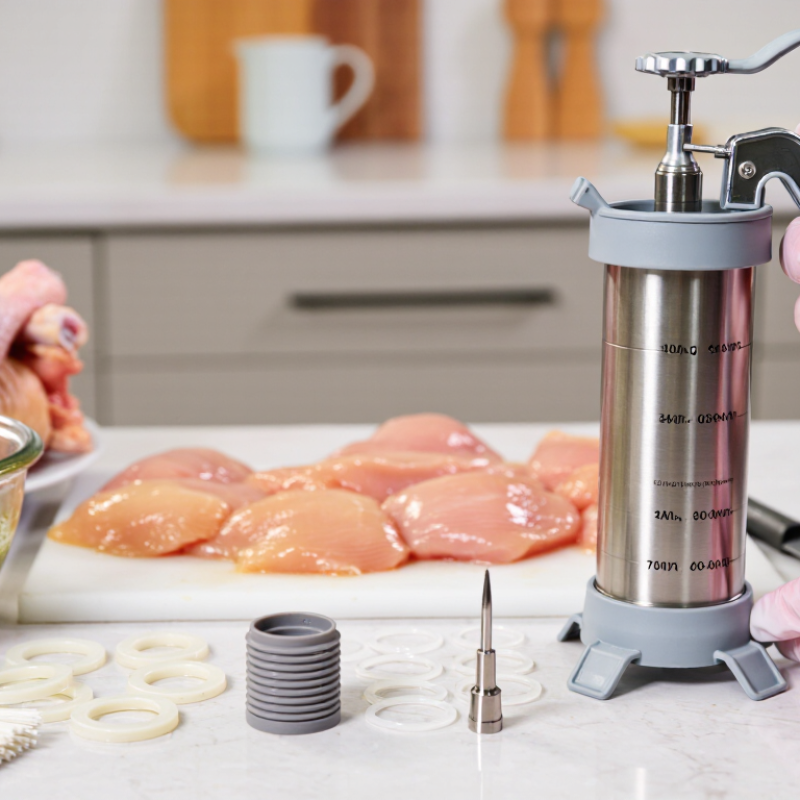
A 30–60 milliliter barrel suits home kitchens and small processing teams. Larger barrels reduce refilling during high-volume work, but they can feel heavy when filled. A clear barrel helps operators check the marinade level and notice trapped air. Some suppliers list maximum capacity only. Ask for the usable capacity instead.
Multiple-hole needles spread marinade across thicker chicken pieces. A single-hole needle gives more precise placement for smaller cuts. The trigger should move smoothly without leaking around the plunger. Test samples with both thin oil-based marinades and thicker mixtures containing herbs. Thick mixtures may clog narrow needles.
They did in one of my early trials. Cleaning then took longer than expected.
Confirm whether measurements use milliliters or fluid ounces. Small specification differences can create purchasing errors across markets. Inspect samples under warm water and repeat the injection test several times. One successful test is not enough. Also review packaging, moisture protection, and carton strength before approving the order.
Choosing a chicken injector for global sourcing requires more than comparing needle counts or quoted prices. In supplier reviews, I check how the machine performs after repeated washing, not just during a showroom test. Stainless steel contact parts should have clear material grades and smooth welds. Seals, pumps, and needles need documented replacement schedules. Ask for batch records, calibration reports, and a practical cleaning video. Small details expose manufacturing discipline.
International compliance starts with the destination market. Request a current declaration of conformity, food-contact documentation, electrical test reports, and risk assessment. Requirements may differ between the European Union, United States, and other regions. Do not accept a certificate without checking its issuer, scope, expiry date, and model number. ISO 9001 supports quality control, but it does not prove food safety by itself. HACCP procedures and traceability records offer stronger evidence of daily control. A supplier’s answer should be specific. Vague promises are expensive.
Audit the factory remotely or in person. Compare the approved sample with production units, packaging labels, manuals, and spare parts. Confirm that voltage, plug type, language, and sanitation instructions match the importing country. I once focused too heavily on certification files and overlooked inconsistent needle alignment. That mistake could have caused uneven injection and costly rework. Build a written acceptance test covering pressure, output consistency, leak resistance, and cleaning time. Leave room for disagreement. Even reliable suppliers can miss a detail when requirements are unclear.
| Evaluation Dimension | Key Requirement | Recommended Benchmark | Documents or Evidence to Request | Weight | Assessment |
|---|---|---|---|---|---|
| Food-contact materials | All wetted parts must be suitable for contact with food and brine. | Material declarations should identify stainless steel grades, elastomers, plastics, and surface treatments. Material selection must comply with the destination market. | Material certificates, food-contact declarations, technical drawings, and supplier statements for seals and tubing. | 15% | Verify |
| Hygienic design | The injector should minimize contamination risks and support effective cleaning. | Prefer smooth, accessible, corrosion-resistant surfaces; removable needles and manifolds; minimal product traps; and drainable components. | Hygienic design drawings, cleaning instructions, disassembly time, photographs, and factory acceptance-test records. | 15% | Verify |
| Injection performance | The machine must deliver consistent brine distribution at the required production rate. | Specify target throughput, injection percentage, product dimensions, brine temperature, pressure range, and allowable variation before requesting quotations. | Performance test report using representative chicken products, calibration records, flow-rate data, and sample inspection results. | 15% | Test Required |
| Cleaning and sanitation | Routine cleaning must be practical, repeatable, and documented. | Require a written sanitation procedure covering water temperature, approved chemical compatibility, inspection points, drying, and reassembly. | Cleaning and sanitation standard operating procedure, chemical compatibility list, spare-parts cleaning guidance, and validation records. | 10% | Verify |
| Machinery safety | Moving parts, needles, electrical systems, and pressure-related hazards must be controlled. | For EU supply, assess conformity with the applicable Machinery Directive or Machinery Regulation transition requirements, electrical safety, and risk-assessment obligations. | Risk assessment, declaration of conformity, user manual, protective-device specifications, and safety-test reports. | 10% | Verify |
| Electrical and EMC compliance | The control system must match the destination country's electrical infrastructure. | Confirm voltage, frequency, phase, enclosure rating, grounding, electromagnetic compatibility, and local plug or wiring requirements before production. | Electrical schematics, component list, EMC test results, insulation tests, IP rating information, and nameplate photographs. | 8% | Verify |
| Quality management system | The supplier should control design, purchasing, production, inspection, and corrective actions. | An independently certified ISO 9001 quality management system is a strong baseline for industrial equipment sourcing. | Current certificate, certification scope, certificate-validity check, audit summary, inspection plan, and nonconformance records. | 8% | Verify |
| Traceability | Critical parts and finished machines must be traceable throughout production and after delivery. | Require serial numbers, revision-controlled drawings, component batch records, inspection records, and documented change control. | Sample device history record, serial-number format, bill of materials, change-control procedure, and spare-part identification system. | 7% | Verify |
| Destination-market documentation | Documentation must support customs clearance, installation, operation, and regulatory review. | Obtain commercial invoice, packing list, country-of-origin information, tariff classification support, manuals, conformity documents, and agreed shipping terms. | Document checklist, sample export package, translated manual, warranty terms, and Incoterms® 2020 quotation. | 5% | Verify |
| After-sales support | The supplier must support installation, training, troubleshooting, and spare-parts availability. | Define response times, remote-support channels, recommended spare-parts package, warranty exclusions, and technician availability before purchase. | Service-level agreement, warranty policy, spare-parts price list, training plan, troubleshooting guide, and reference-site contact details. | 5% | Verify |
| Total Evaluation Weight | 100% | Score After Verification | |||
Choosing the best chicken injector for your supply chain requires more than comparing prices. Start with your production volume, marinade thickness, and batch schedule. A small kitchen may need a simple hand injector, while a processing facility needs stable pressure and repeatable dosing. The injector should handle frequent use without leaking around the plunger or fittings.
Check the needle design carefully. Multiple openings can distribute marinade more evenly through thick chicken breasts. Stainless steel contact parts are easier to clean and generally resist corrosion. Ask suppliers for material specifications, cleaning instructions, sample units, and performance records. During testing, measure injection weight before and after each cycle. A difference of several grams can affect yield and customer consistency. Packaging also matters when importing. Strong cartons, spare seals, and clear assembly instructions reduce delays at the receiving site.
Tips: Test a sample with your actual marinade, not plain water. Inspect the needle after repeated use. Confirm replacement-part availability and response times. Review production capacity before placing a large order. A low unit price can become expensive when seals fail or shipping stops. I have found that supplier communication often predicts long-term reliability, but it is not a perfect measure. Even a confident supplier may overlook small details. Record every test result, including cleaning time, leakage, and operator comfort. That evidence supports a safer, more dependable sourcing decision.
Select equipment by prioritizing food-contact compliance, injection consistency, production capacity, cleaning efficiency, after-sales support, and total cost. The weighting below provides a practical supply-chain evaluation framework.
Key takeaway: Compliance and consistent brine distribution should receive the highest priority, followed by throughput and hygienic design. Purchase price is important, but it should not outweigh food safety, product consistency, or long-term operating reliability.
A manual injector often fits small batches, test kitchens, and seasonal work. It offers direct control. Large orders may cause hand fatigue.
Pneumatic models suit medium-sized facilities with stable air systems. They provide faster, more consistent brine distribution. Check local air pressure before ordering.
Multi-needle injectors can support continuous, high-volume lines. They require disciplined cleaning and maintenance. More needles mean more cleaning points.
Single-needle models work well for irregular orders and customized recipes. They are simple to adjust. Output is limited, though.
Choose strong hollow needles with suitable openings for the marinade. Multiple side ports can spread thicker brines through chicken breasts. Inspect needles after repeated use.
Food-contact parts should use corrosion-resistant stainless steel. Removable needles, washable seals, smooth welds, and rounded corners reduce residue buildup. Cleaning access matters greatly.
Use your actual chicken cuts and marinade, not plain water. Record injection weight before and after each cycle. Check leakage, cleaning time, and operator comfort.
Confirm voltage, air pressure, packaging, manuals, material certificates, and inspection records. Ask about spare seals and local servicing. Cheap equipment may become expensive after delays.
Thin brine may flow easily through most needles. Thicker marinades need suitable openings and stable pressure. A successful water test proves very little.
Uneven injection can create dry centers and salty pockets. Pressure gauges may drift. Check calibration records and test several batches before approval. Even good results can be temporary.
Choosing the best Chicken Injector for global sourcing requires a clear understanding of product types, intended applications, and supply chain requirements. Manual, multi-needle, and commercial-grade injectors serve different production volumes and seasoning processes, so buyers should assess workflow, injection precision, capacity, ease of cleaning, and operator safety. High-quality models typically use durable, food-safe materials, reliable seals, ergonomic handles, and needles designed to distribute marinades evenly without unnecessary waste.
A complete sourcing evaluation should compare material strength, reservoir size, injection consistency, maintenance needs, packaging, and total ownership cost. Suppliers should also be reviewed for manufacturing reliability, quality control systems, traceable documentation, and certifications relevant to food-contact equipment and international trade. By balancing performance, durability, compliance, delivery capability, and after-sales support, buyers can select a Chicken Injector that fits their production scale and remains dependable across markets. A structured comparison process helps reduce sourcing risks while supporting consistent product quality and efficient global supply chain operations.

Weinuoer